
Part Two – Why we surf: Flow, happiness and meaning
By Ross Phillips, founder of Tropicsurf
Picking up from the personal stories, this second part explores the deeper question Ross kept returning to – whether surfing is simply fun, or something closer to a philosophy of happiness.
Beyond the thrill, the mental benefits of surfing are what keep many of us coming back — from clarity and presence to a deeper sense of happiness.
Surfing and the Philosophy of Happiness
The pursuit of happiness has tested philosophers and poets of nearly every civilisation. Around 335 BC, Aristotle spoke of a concept he termed “Eudaimonia”, which translates roughly to “good spirit”. This Greek word refers to being in a contented state of health, happiness, and prosperity. In moral philosophy, eudaimonia is used to refer to the right actions that result in the well-being of an individual. These days, modern academics, authors, and self-help gurus continue this quest to pin down the meaning of happiness, with many charging exorbitant fees for their unique formulas. (I once saw a website on breatharianism which offered the “secret to immortality” in the “fifth dimension” for the cost of one billion USD.)
But do all pleasures equally lead to happiness? Academics talk of two types of pleasure: authentic and inauthentic. Examples of authentic pleasures may include immersion in creation and learning by oneself, the path towards spiritual enlightenment, or the profound gratitude from helping someone in need. Even the simplest of pleasures, like laughter at a dinner party with old friends, the loving smile of one’s offspring, or mindfully observing the breeze in the trees, are all examples of authentic pleasures. In contrast, experts cite examples of inauthentic pleasures as those gained from artificial highs, such as that from drug consumption, or perhaps online life in the metaverse.
Back in downtown Athens, Aristotle linked his concept of eudaimonia to the concept of “autotelic activity”. This refers to the things we do for their own sake and not for the sake of something else. Or, as psychologist Mihaly Csikszentmihalyi notes, we are measurably happier when involved in skilful, challenging pursuits which have clear goals and ongoing feedback. Examples could include learning to paint, higher studies, and most definitely surfing. Pursuits that we undertake not necessarily for the end result but rather for the intrinsic value of the journey. Henry Thoreau summed it up when he said: “The value of any experience is measured, of course, not by the amount of money, but the amount of development we get out of it.”
Humans strangely often value tough or painful experiences. A life of easy pleasure or idle anaesthesia is sometimes a restless one. In modern times, materialistic goals such as money, fame, image, and power have been proven not to be linked to happiness, yet they are highly prized in Western culture. In contrast, non-materialistic goals such as personal development, spiritual sanctification, intimate relationships, community contribution, helping others, meaningful work, and progress towards goals have been proven to lead to contentment.
A Lifetime in a Single Wave
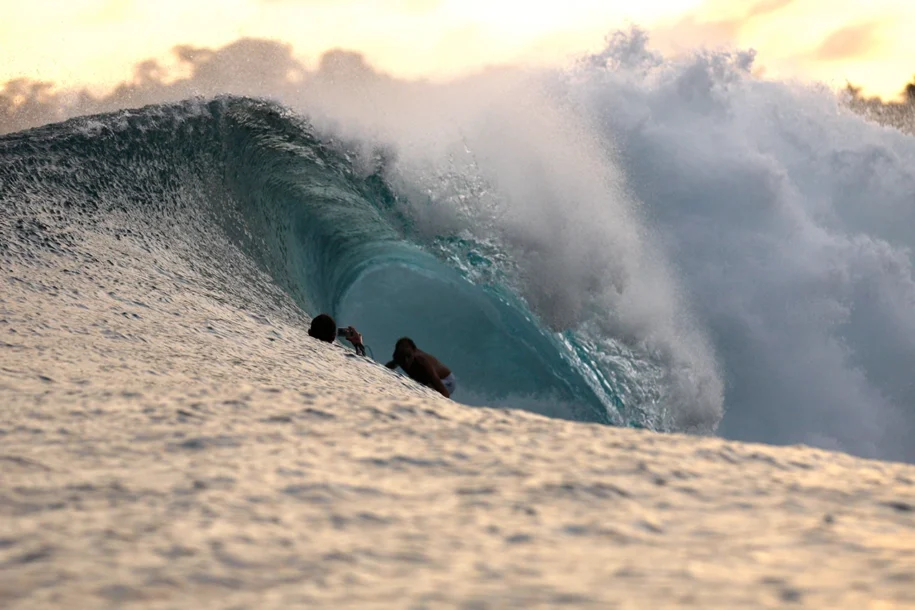
As a purveyor of luxury surfing holidays through my business, I like to ask myself this question: Is surfing a genuine path to happiness or just a hedonistic and superficial pastime? I have now surfed for more than 50 years, but it was one particular wave that caught my attention on this matter. It was a growling tube ride over a slab of live coral in remote Indonesia. It was nothing longer than a 10-second rush, but a rush that had taken me a lifetime to accomplish. And strangely it inhabits an unusually vivid and disproportionate allocation of my memory bank: the “rest” of my life seems to occupy about 50% of my mind and that one special ride the other half. These are special memories indeed, hard-earned. The reef scars all over my body will attest to that. But years later, the memory of that one brief moment brings a delightful smirk to my face. An unusual yet undeniable wealth that I feel more than I can count. Surfing is astonishingly difficult. It takes a lifetime of trying to master. And nobody truly accomplishes this anyway. But what I’ve learned is that it’s not the mastery that leads to happiness. It’s the small steps of the journey along the way. It’s the showing up and the participation.
Flow, Tribe, and Presence
I’ll never ever forget my first green wave. These special moments are acquired with a level of challenge that is integral to the contentment. We get to be part of a tribe. We commune with nature. We meditate in moments of stillness. The glide of the ride thrusts us into an immediate mental state of flow, where time slows and outside distractions vanish. You can’t cheat at surfing and when you consider surfing this way, it certainly fits Aristotle’s criteria for eudaimonia.
Or consider these words from Dr Timothy Leary:
“Surfers are the ‘throw-aheads’ of mankind. The act of the ride is the epitome of ‘be here now’. Your future is right ahead of you, the past is exploding behind you, your wake is disappearing, your footprints are washed from the sand. It’s a non-productive, non-depletive act that’s done purely for the value of the dance itself. And that is the destiny of man.”
The Privilege of the Ocean
I’m not a big believer that surfing is the most important thing in life, but it is one heck of a pleasure. And because it is inherently difficult, that’s what makes it satisfying.
As surfers, I reckon we’ve all won the lottery. To be able to confidently enjoy playing in the ocean is a privilege that everyone should get to enjoy. I’ve now spent the better part of four decades building a pedagogy, team, and network of luxury resort locations and local partnerships. At Tropicsurf our mission is to allow people from all walks of life to enjoy surfing in safety, comfort, and style. We have the expertise and locations to allow you to feel the stoke and make never-ending progress. And the best thing is that you don’t need any prior experience. Just a desire to live in the moment and feel fully alive in your skin.
Find out more about Tropicsurf.